

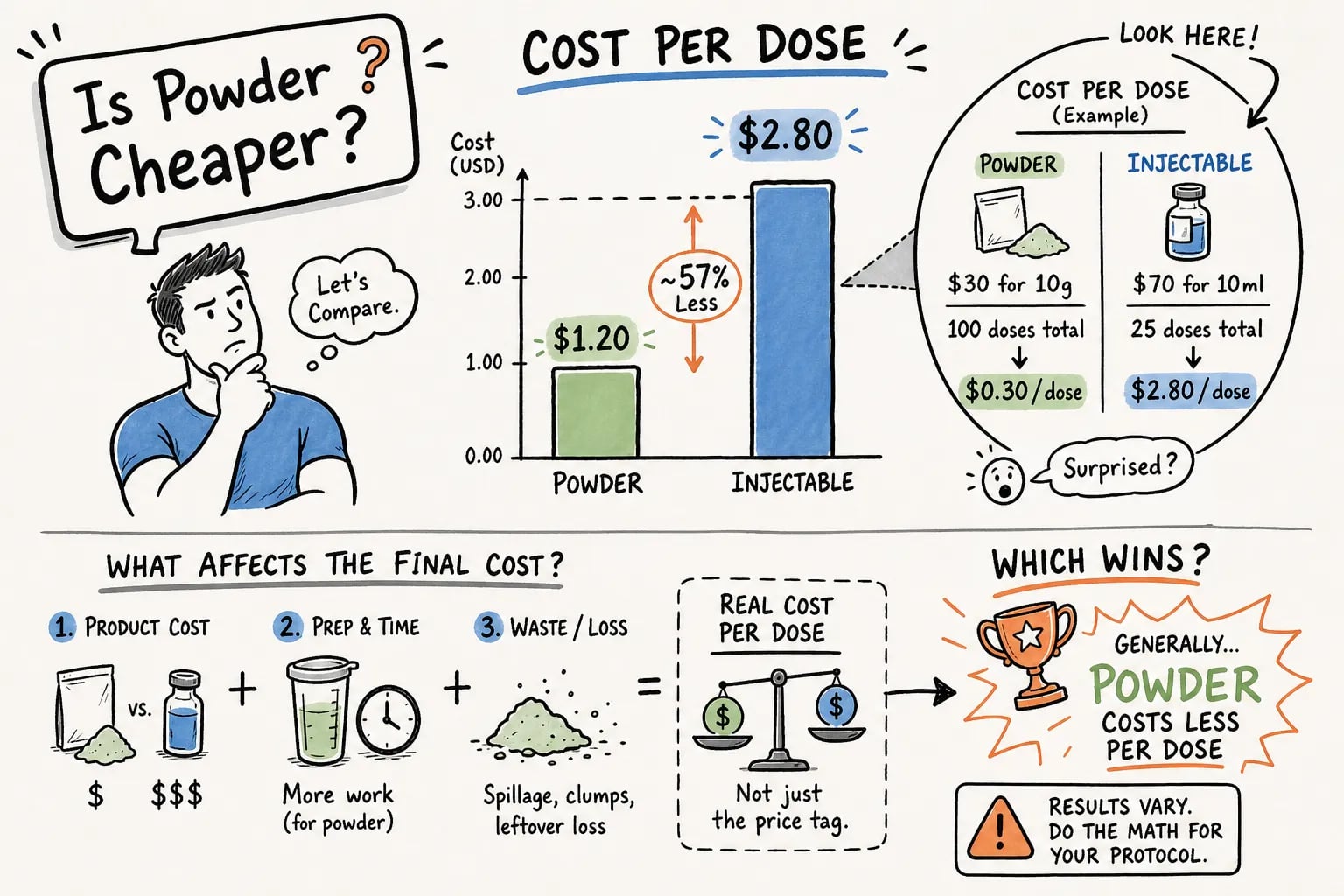
Is it cheaper to buy raw steroid powder or finished injectables? The math looks obvious at first glance. Raw testosterone enanthate powder runs less than $1.50 per gram at the source. A finished 10mL vial of the same compound sells for $30 to $60 online. The per-gram price sheet makes the raw route look like an easy win. Most buyers stop thinking right there.
That’s the mistake. The invoice price on a raw powder order is not the cost of a dose. It’s the cost of a starting material. Between that powder and an actual injectable sits a chain of expenses most buyers either underestimate or ignore: conversion supplies, equipment, quality testing, batch risk, and the legal exposure that runs underneath all of it.
This article is a true cost-per-dose comparison, not a surface-level price list. We’ll build the full picture from API cost through finished dose so you can run your own numbers and make the right call for your situation. To keep the math grounded, we’ll use BodybuildingCycleOnline as a real-world anchor. Their minimum raw powder orders start at 10 grams, which is a realistic starting point for anyone seriously considering the bulk steroid suppliers route.
What Raw Steroid Powder Actually Costs at the Source
At the manufacturer level, common testosterone esters are genuinely cheap. Testosterone enanthate runs approximately $0.42 to $1.50 per gram depending on quantity and purity documentation. Trenbolone acetate lands between $1.40 and $3.95 per gram. Drostanolone propionate sits around $1.15 to $1.35 per gram. Turinabol pushes to $3.80 per gram or higher. The testosterone derivatives are where the bulk-savings argument is strongest, because the per-gram API cost is low enough that even with markup layers, there’s room for savings if everything else goes right.
At a 10-gram minimum order, the raw API cost for testosterone enanthate is roughly $15. That 10 grams gives you 10,000mg of active compound. Brewed at 250mg/mL in 10mL vials, you get 40 vials from a single 10g order. The API cost per vial works out to under $0.50. On paper, that number is striking. In practice, it’s only the first line on the invoice.
Prices also vary significantly by supplier. A catalog listing and an actual manufacturing quote are not the same thing. Purity documentation, minimum order tiers, and whether you’re buying from an actual cGMP facility or a middleman all affect real pricing. That’s why sourcing matters as much as the number on the page.
The Conversion Bill: What It Actually Costs to Turn Steroid Raws Into an Injectable
To brew an injectable from raw API, you need pharmaceutical-grade carrier oil (MCT, grapeseed, or ethyl oleate), benzyl alcohol as a preservative, benzyl benzoate as a co-solvent, sterile vials, stoppers, aluminum crimp caps, and 0.22-micron sterile syringe filters. None of these are optional if you want a usable, injectable product. Per 100mL batch, rough consumable costs break down like this: carrier oil runs $3 to $8, BA and BB together add $2 to $5, ten 10mL vials with caps cost $8 to $15, and syringe filters run $5 to $12 each with two recommended per batch. Total consumables per 100mL batch: approximately $18 to $40. Factor in conversion consumables and that adds $0.18 to $0.40 per mL before you touch equipment or testing.
Cost Per mg Steroid: Equipment You Can’t Skip
Equipment is the cost most first-timers forget to account for. A digital hotplate and stirrer costs $40 to $120. A precision milligram scale runs $25 to $80. A vial crimper adds $30 to $100. A sterile work environment, whether a laminar flow hood or a well-built still-air box, costs $150 to $600 or more. Miscellaneous glassware adds another $30 to $80. Total equipment investment: $275 to $980 depending on how seriously you take contamination control. These costs don’t disappear after the first batch, but they also don’t divide evenly across two batches the way they do across twenty.
For a personal-use buyer running one or two cycles a year, equipment costs alone can exceed the total price of buying finished injectables for an entire cycle. The math only tilts in favor of raw steroid powder when you’re spreading those fixed costs across meaningful production volume.
Quality Testing and Third-Party Fees: The Expense Most DIY Buyers Skip
A third-party HPLC purity test for a raw steroid powder runs approximately $150 to $300 per sample through a U.S. independent lab. LC-MS identity confirmation adds another $200 to $400. Endotoxin testing on a finished injectable batch runs $110 to $350. Sterility testing adds $150 to $300. If you test the API on arrival and the finished brew before injecting, you’re looking at $400 to $1,000 in testing costs per compound per batch, which adds $4 to $10 per mL depending on batch size.
Most buyers skip this step. That’s a bet that the supplier’s documentation is accurate and that your brew went correctly. It’s not an unreasonable bet if you’re sourcing from a manufacturer with verified purity documentation and a solid track record. But it’s still a bet, and the financial downside of a bad batch extends well beyond the cost of the materials.
A contaminated or incorrectly concentrated batch means a total write-off. On a 10g brew with conversion consumables, that’s a $30 to $80 loss minimum, plus sourcing costs for a replacement order. Finished injectable suppliers absorb this manufacturing risk entirely. That’s part of what the markup pays for, and it’s a legitimate cost to assign to the raw route when comparing honestly.
What Finished Injectable Pricing Actually Covers
A finished vial from a reputable supplier isn’t just API in oil. It includes formulation at verified concentration, sterile fill-finish in a controlled environment, crimped vials, basic QA oversight, packaging, and distribution handling. Industry fill-finish cost models put sterile fill-finish at $0.50 to $3.50 per vial at commercial scale. Packaging and administration materials add another $0.50 to $8.00 per vial. QA spread across a production batch adds a few dollars per unit. These are real costs carried by the supplier, not margin padding.
When you compare per-mL numbers directly, the gap between raw and finished looks significant at the API cost level. Raw testosterone enanthate at $1.50/g brewed to 250mg/mL gives an API cost of $0.375 per mL. A pharmaceutical-grade steroid finished into a 10mL vial at the same concentration from an online supplier typically runs $30 to $60, or $3 to $6 per mL.
Add in conversion consumables ($0.18 to $0.40/mL), equipment amortization on small batches, and testing if done correctly ($4 to $10/mL), and the raw route lands closer to $4.50 to $11 per mL. The savings shrink considerably and can disappear entirely on small batches. At scale, with equipment already paid off and consistent large-batch production, the raw route still wins. For a single-cycle buyer running two or three batches a year, the numbers often tell a different story.
Legal Exposure That Changes the Entire Calculation
Anabolic steroids are Schedule III controlled substances under U.S. federal law. Purchasing, importing, or manufacturing them without DEA registration is a federal offense. That applies to finished injectables and raw powder alike. But the raw powder route adds an additional layer: the compounding step itself. If converting raw API into an injectable is treated as manufacturing a Schedule III substance without DEA registration, it triggers manufacturing charges on top of possession risk. Under 21 U.S.C. § 841, that exposure reaches up to ten years’ imprisonment and fines up to $500,000 per instance for an individual.
Importing raw API also runs into FDA registration and drug listing requirements that apply to foreign manufacturing facilities. A shipment without proper documentation can be seized under import alert provisions. A seized shipment is a 100% financial loss with no recourse: product cost, shipping cost, and any testing fees paid in advance are all gone. If the package is tracked back to the buyer, downstream legal consequences can dwarf any savings from the bulk order.
Discreet packaging from a reputable supplier reduces detection risk. It does not change the legal status of the transaction. The probability-weighted cost of seizure or legal exposure belongs in your cost comparison. Most buyers don’t include it. That omission is how buying raw steroid powder can look cheaper than it actually is.
The Honest Verdict: When Each Route Actually Makes Sense
Raw powder makes genuine financial sense for buyers operating at scale with proper infrastructure. If your equipment is paid off, you’re running consistent large batches, and you have access to third-party testing, the per-dose savings are real. Underground lab operators and high-volume buyers with established workflows are the buyers for whom this math actually works out. For that group, sourcing from a direct-from-manufacturer supplier like BodybuildingCycleOnline with 10g minimums and verified purity documentation gives the lowest starting API cost and the clearest baseline for calculating real savings. Their cGMP manufacturing and HPLC documentation also give you a solid foundation before you spend money on third-party testing.
For single-cycle buyers, first-time users, or anyone without established brewing equipment and testing protocols, finished injectables almost always win on a true cost-per-dose basis. The convenience premium on a finished vial isn’t laziness tax. It’s payment for someone else absorbing material waste, batch failure risk, and QA burden. For most buyers running one or two cycles a year, that premium is the more economical choice when total cost is calculated honestly.
The cheapest route isn’t the one with the lowest per-gram invoice price. It’s the one where every milligram you paid for is actually in the dose you inject. When you ask whether it’s cheaper to buy raw steroid powder or finished injectables, the only honest answer is: it depends on your volume, your infrastructure, and how fully you account for every cost in the chain.
Run the Real Numbers Before You Decide
The cost buckets in this article are the ones most buyers ignore: API cost, conversion consumables, equipment amortized across your actual batch volume, quality testing, batch failure probability, and legal exposure weighted by realistic risk. Add them up for your specific situation before defaulting to the assumption that bulk automatically means cheaper. Whether you’re comparing the cost per mg steroid or total cycle spend, the full picture almost always looks different from the first number on the page.
If you’re evaluating the raw powder route seriously, start with accurate API pricing from a verified manufacturer source. BodybuildingCycleOnline publishes pricing on steroid raws including testosterone derivatives, Primobolan, and DHB, with purity documentation available before you order. Use that as your API baseline, then build the rest of your cost model from there. The decision should come from the full picture, not just the first number on the page.
FAQ: Raw Steroid Powder vs. Finished Injectables
Is it cheaper to buy raw steroid powder or finished injectables overall?
At high production volumes with equipment already paid off, raw powder is genuinely cheaper per dose. For buyers running one or two cycles a year, finished injectables typically win once you account for consumables, equipment, and testing costs.
How much does third-party HPLC testing cost?
A standard HPLC purity test through a U.S. independent lab runs approximately $150 to $300 per sample. LC-MS identity confirmation adds another $200 to $400. Most DIY brewers skip this step entirely, which is a meaningful financial and safety risk.
Is raw powder legal to import into the United States?
Anabolic steroid raw powders are Schedule III controlled substances under federal law. Importing them without DEA registration is a federal offense. Shipments can be seized under import alert provisions, resulting in a total financial loss with no recourse.
What are bulk steroid suppliers, and how do they price raw API?
Bulk steroid suppliers sell active pharmaceutical ingredients (API) in gram quantities directly to buyers. Pricing varies by compound, purity documentation, and order volume. Common testosterone derivatives start below $1.50 per gram at the 10g minimum, with higher-complexity compounds like Turinabol pushing above $3.80 per gram.